Images of the Ancestors
Exploration of memory and identity
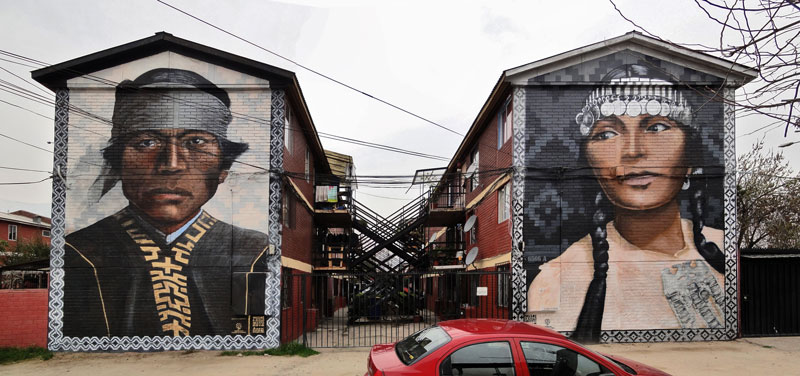
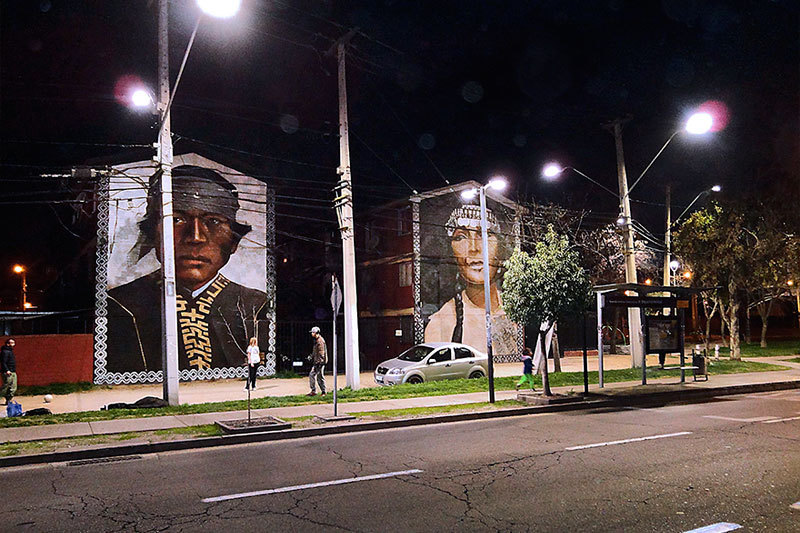
The series Images of the Ancestors brings together works that pay tribute to the original cultures of the Chilean territory. Through muralism and interventions in public space, these pieces seek to make visible the memory, spirituality, and resistance of Indigenous peoples, incorporating elements of identity, genealogy, and historical reflection.
This line of work is oriented less toward decoration and more toward recognition: painting as a way to leave a trace, open questions, and connect with what has often been denied or silenced. Each work is built from respect for the territory and its people, understanding that these images are also spaces of encounter and dialogue.

Two main formats coexist in this branch. On one hand, muralism as public portrait: the series Musoe Open Air gathers mural diptychs dedicated to Indigenous peoples, installing their faces and symbols at the everyday scale of the neighborhood. On the other hand, there is action / photo-performance + video: Urban Mapuche: The Felling of Memory works with the presence of the body and the sign in urban space to open a reflection on interrupted memory, inheritance, and conflict.
Rather than illustrating "the ancestral," these works propose an ethics of looking: recognizing territory as a living layer of history, tensions, and affections. The gesture of painting, recording, or intervening is understood as a form of symbolic repair and public conversation, where the image functions as a threshold between past and present, between identity and question.
In this way, Images of the Ancestors is conceived as an open field of work: an expanding series that articulates visual work, research, and community presence, seeking an image that does not close meaning but activates it; that does not impose a single narrative, but enables a shared space of reading.